Exact2Pass

Last Update 21 hours ago Total Questions : 75
The Pure Storage FlashBlade Certified Architect Professional (FBAP_002) Exam content is now fully updated, with all current exam questions added 21 hours ago. Deciding to include FBAP_002 practice exam questions in your study plan goes far beyond basic test preparation.
You'll find that our FBAP_002 exam questions frequently feature detailed scenarios and practical problem-solving exercises that directly mirror industry challenges. Engaging with these FBAP_002 sample sets allows you to effectively manage your time and pace yourself, giving you the ability to finish any Pure Storage FlashBlade Certified Architect Professional (FBAP_002) Exam practice test comfortably within the allotted time.
A customer reports far lower than expected performance on the FlashBlade, in a Oracle RMAN backup solution. The environment consists of four Oracle database nodes, each with 1x10Gb/s NIC, connected via NFS, to a fully populated FlashBlade chassis. Only a small number of blades are being used. Synthetic performance testing shows no performance issues in the network.
What should the architect suggest to causing this issue?
The customer wants to build a software QA infrastructure using modern big data tools like Spark and Kafka. The goal is to process 50 billion events per day and provide feedback in real-time in less than 5 seconds.
The architect needs to create a FlashBlade configuration to meet the capacity and performance requirements using the following assumptions:
4 RSyslog servers accessing FlashBlade via NFS
6 servers accessing FlashBlade via S3
Capacity: 6TB + 18TB + 18TB
Each protocol will create a concurrent write and / or read throughput of 6GB/s
Which configuration should the architect use to meet these requirements?
A customer is using an older nearline SAS scale-out storage system to store data that is a static size. The customer recently purchased several HPC appliances to use that data.
What happens to the workflow?
A customer asks an architect to help troubleshoot low throughput in their high-performance compute (HPC) environment. All 70 HPC nodes have a single 10Gb connection to a 96 port 10Gb switch. The FlashBlade is connected to their dedicated HPC switch with 8x10Gb connections. The HPC application is using a single shared S3 bucket for the data being processed.
Which change is needed to increase throughput?
A customer has 7x52TB FlashBlade, which is ~70% full. One 52TB blade is added.
Which two results should the architect expect? (Select two.)
A customer is deploying a FlashBlade into a datacenter where the top of rack switches cannot be configured into a single LAG.
Which two actions are necessary to configure the FlashBlade to use both switches? (Choose two.)
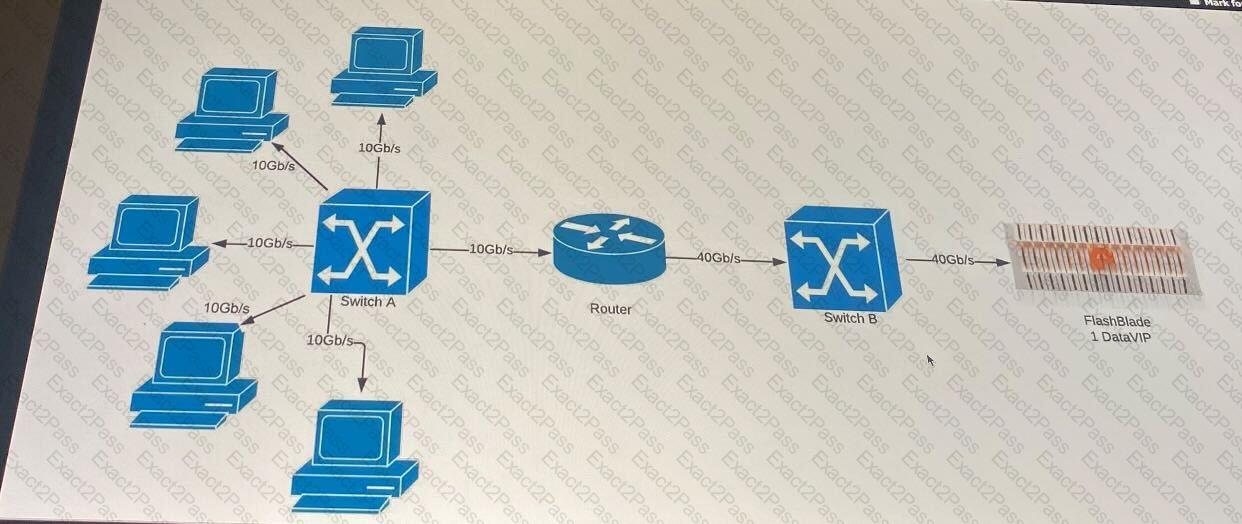
The customer reports that the end clients shown in the diagram are NOT completing jobs on time. Each client writes 300MB/s to the FlashBlade for 45 minutes every hour, and they run concurrently. What does the architect need to do?
How many rack units does a FlashBlade system with 39 blades consume?
A customer’s application runs slowly on their HDFS cluster. The customer is only using a small subset of the data on the cluster.
What is causing the issue?
An HPC environment has the following:
- 100 physical hosts, each with a single 10GbE NIC, and a single NFS mount point to the FlashBlade.
- A 7x52TB FlashBlade, connected to the Top-of-Rack switches via eight 40GbE connections.
What is the maximum aggregate write throughput the customer should expect from the FlashBlade?

