Exact2Pass

Last Update 59 minutes ago Total Questions : 62
The Ericsson Certified Associate - Radio Network Optimization content is now fully updated, with all current exam questions added 59 minutes ago. Deciding to include ECP-383 practice exam questions in your study plan goes far beyond basic test preparation.
You'll find that our ECP-383 exam questions frequently feature detailed scenarios and practical problem-solving exercises that directly mirror industry challenges. Engaging with these ECP-383 sample sets allows you to effectively manage your time and pace yourself, giving you the ability to finish any Ericsson Certified Associate - Radio Network Optimization practice test comfortably within the allotted time.
What are two benefits of massive MIMO? (Choose two.)
Review the exhibit.
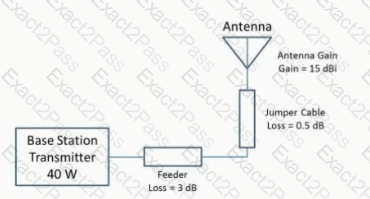
What is the EIRP of the transmitter shown In the exhibit?
You have collocated sectors In your 2G network on the GSM 900 and the DCS 1800 bands. Reviewing the network level traffic distribution, you noticed that the GSM 900 sectors have five times more traffic than the DCS 1800 sectors.
Which two actions would improve load balancing between these bands? (Choose two.)
A user is participating in an IR.92 compliant VoLTE call.
What is the Quality of Service Class Indicator (QCI) of the bearer that carries SIP signaling?
You are making a frequency plan for a new site and you need to create an interference matrix for new GSM sectors.
In this scenario, which three inputs should you use? (Choose three.)
Which two statements are true about 64 QAM modulation in the downlink direction? (Choose two.)
Which multiple access technique is used In LTE radio DL?
Which two statements correctly describe Single Carrier Frequency Division Multiple Access (SC-FDMA) as used in LTE systems using uplink SIMO? (Choose two.)
What are two advantages of using the Data Forwarding at Intra-LTE Handover feature? (Choose two.)
A customer has Identified problems In an Indoor, medium loaded, urban area of a GSM/WCDMA collocated network. The problem seems to be in the uplink. The signal level received by the problematic site is high, and the downlink signal in the problematic area is acceptable.
Which two actions would you use to troubleshoot the issue? (Choose two.)

