Spring Sale Special Limited Time 70% Discount Offer - Ends in 0d 00h 00m 00s - Coupon code: buysanta

Exact2Pass Menu

Salesforce Certified MuleSoft Developer 2 (SU24)

Last Update 17 hours ago Total Questions : 60

The Salesforce Certified MuleSoft Developer 2 (SU24) content is now fully updated, with all current exam questions added 17 hours ago. Deciding to include Salesforce-MuleSoft-Developer-II practice exam questions in your study plan goes far beyond basic test preparation.

You'll find that our Salesforce-MuleSoft-Developer-II exam questions frequently feature detailed scenarios and practical problem-solving exercises that directly mirror industry challenges. Engaging with these Salesforce-MuleSoft-Developer-II sample sets allows you to effectively manage your time and pace yourself, giving you the ability to finish any Salesforce Certified MuleSoft Developer 2 (SU24) practice test comfortably within the allotted time.

Question # 1

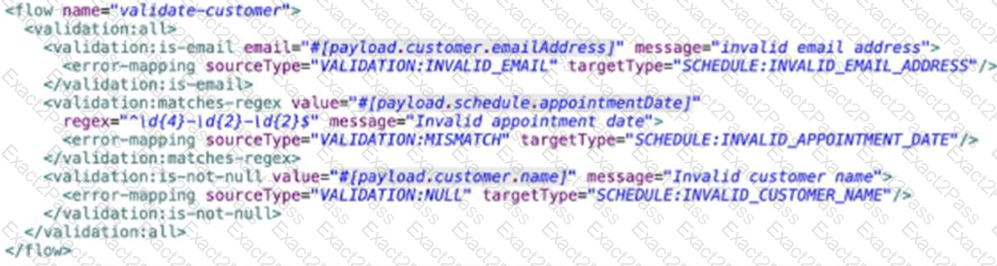
An API has been built to enable scheduling email provider. The front-end system does very little data entry validation, and problems have started to appear in the email that go to patients. A validate-customer’’ flow is added validate the data.

What is he expected behavior of the ‘validate-customer’’ flow?
A.

If only the email address Is invalid a VALIDATION.INVALID_EMAIL error is raised

B.

If the email address is invalid, processing continues to see if the appointment data and customer name are also invalid

C.

If the appointment date and customer name are invalid, a SCHEDULE:INVALID_APPOINTMENT_DATE error is raised

D.

If all of the values are invalid the last validation error is raised:SCHEDULE:INVALID_CUSTOMER_NAME

Question # 2

Which pattern can a web API use to notify its client of state changes as soon as they occur?

A.

HTTP Webhock

B.

Shared database trigger

C.

Schedule Event Publisher

D.

ETL data load

Question # 3

Multiple individual Mute application need to use the Mule Maven plugin to deploy to CloudHub.

The plugin configuration should .. reused where necessary and anything project, specific should be property-based.

Where should the Mule Maven details be configured?

A.

A parent pom.xml

B.

Settings, xml

C.

Pom, xml

D.

A Bill of Materials (BOM) parent pm

Question # 4

A scatter-gather router is configured with four routes:Route A, B, C and D.

Route C false.

A.

Error,errorMesage.payload.results [‘2’]

B.

Payload failures[‘2’]

C.

Error,errorMessage,payload.failures[‘2’]

D.

Payload [‘2’]

Question # 5

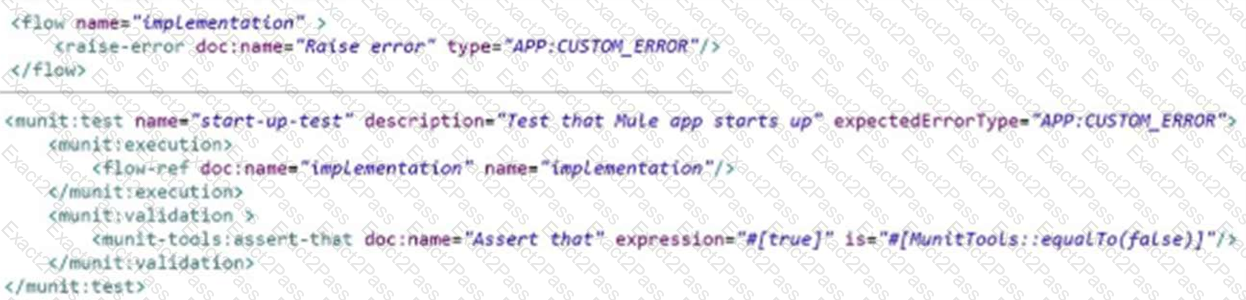
Refer to the exhibit.

The flow name is ‘’implementation’’ with code for the MUnit test case.

When the MUnit test case is executed, what is the expected result?

A.

The test case fails with an assertion error

B.

The test throws an error and does not start

C.

The test case fails with an unexpected error type

D.

The test case passes

Question # 6

Which configurations are required for HTTP Listener to enable mTLS authentication?

A.

Set an appropriate reconnection strategy and use persistent connections for the listener

B.

Set an appropriate keystore configuration and use persistent connections for the listener

C.

Set an appropriate keystore and truststore configuration for the listener

D.

Set an appropriate truststore configuration and reconnection strategy for the listener

Question # 7

Which statement is true about using mutual TLS to secure an application?

A.

Mutual TLS requires a hardware security module to be used

B.

Mutual TLS authenticates the identity of the server before the identity of the client

C.

Mutual TLS ensures only authorized end users are allowed to access an endpoint

D.

Mutual TLS increases the encryption strength versus server-side TLS alone

Question # 8

A Mule application defines as SSL/TLS keystore properly ‘tis,keystore.keyPassword’’ as secure.

How can this property be referenced to access its value within the application?

A.

#{secure::tiskeystore,keyPassowrd}

B.

${secure::tiskeystore,keyPassowrd}

C.

${secure::tiskeystore,keyPassowrd}

D.

p{secure::tiskeystore,keyPassowrd}

Question # 9

In a Mule project, Flow-1 contains a flow-ref to Flow-2 depends on data from Flow-1 to execute successfully.

Which action ensures the test suites and test cases written for Flow-1 and Flow-2 will execute successfully?

A.

Chain together the test suites and test cases for Flow-1 and Flow-2

B.

Use ‘’Set Event to pass the input that is needed, and keep the test cases for Flow-1 and Flow-2 independent

C.

Use ‘’Before Test Case’’ To collect data from Flow-1 test cases before running Flow-2 test cases

D.

Use ‘After Test Case’ to produce the data needed from Flow-1 test cases to pass to Flow-2 test cases

Question # 10

A Mule application need to invoice an API hosted by an external system to initiate a process. The external API takes anywhere between one minute and 24 hours to compute its process.

Which implementation should be used to get response data from the external API after it completes processing?


A.

Use an HTTP Connector to invoke the API and wait for a response

B.

Use a Scheduler to check for a response every minute

C.

Use an HTTP Connector inside Async scope to invoice the API and wait for a response

D.

Expose an HTTP callback API in Mule and register it with the external system

Go to page: