Exact2Pass

Last Update 10 hours ago Total Questions : 107
The Enterprise Routing and Switching Specialist (JNCIS-ENT) content is now fully updated, with all current exam questions added 10 hours ago. Deciding to include JN0-351 practice exam questions in your study plan goes far beyond basic test preparation.
You'll find that our JN0-351 exam questions frequently feature detailed scenarios and practical problem-solving exercises that directly mirror industry challenges. Engaging with these JN0-351 sample sets allows you to effectively manage your time and pace yourself, giving you the ability to finish any Enterprise Routing and Switching Specialist (JNCIS-ENT) practice test comfortably within the allotted time.
Which two BGP attributes must be supported by all BGP implementations and must be included in every update? (Choose two.)
Your network has two ISPs available. You want to ensure that all outbound traffic is routed out ISP-1. If the connection to ISP-1 fails, all outbound traffic is routed to the backup ISP ISP-2. In this scenario, how should you configure BGP on your network?
What are two purposes of an aggregate route? (Choose two.)
What is a purpose of using a spanning tree protocol?
Exhibit.
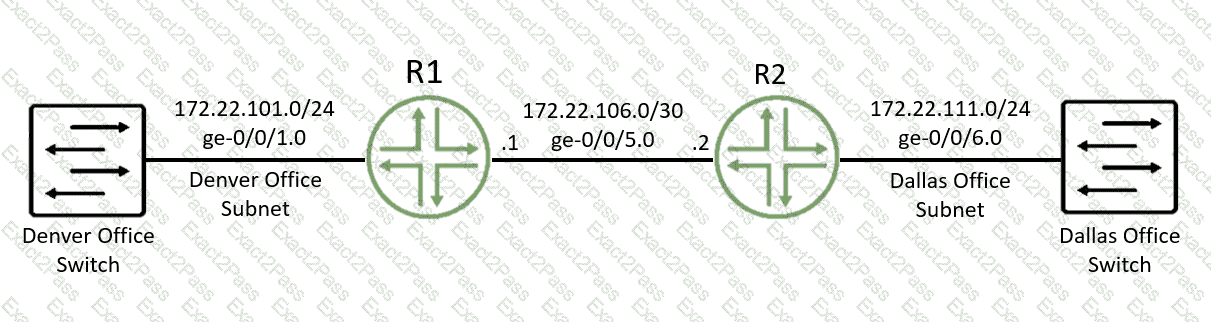
You are using OSPF to advertise the subnets that are used by the Denver and Dallas offices. The routers that are directly connected to the Dallas and Denver subnets are not advertising the connected subnets.
Referring to the exhibit, which two statements are correct? (Choose two.)
You are configuring a router as a new Level 1 router in an existing Level 1 area. The NET address for an existing Level 1 router is 49.0011.1111.2222.3333.00. The new router must form a Level 1 adjacency with the existing router.
What should be the area ID in this scenario?
Click the Exhibit button.
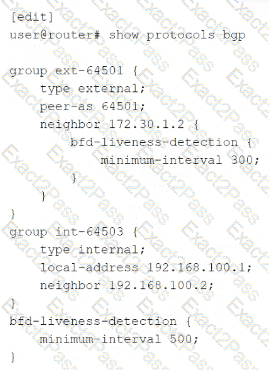
Which statement concerning Bidirectional Forwarding Detection (BFD) is true for the configuration shown in the exhibit?

