Exact2Pass

Last Update 6 hours ago Total Questions : 69
The Adobe Commerce Developer Expert content is now fully updated, with all current exam questions added 6 hours ago. Deciding to include AD0-E716 practice exam questions in your study plan goes far beyond basic test preparation.
You'll find that our AD0-E716 exam questions frequently feature detailed scenarios and practical problem-solving exercises that directly mirror industry challenges. Engaging with these AD0-E716 sample sets allows you to effectively manage your time and pace yourself, giving you the ability to finish any Adobe Commerce Developer Expert practice test comfortably within the allotted time.
A Project Architect needs to add a new developer who needs to be able to push code in an Adobe Commerce Cloud project. No integration with a third-party repository provider is setup.
What two actions would be required to ensure the developer has access? (Choose Two.)
An Adobe Commerce developer is working on a Magento 2 instance which contains a B2C and a B2B website, each of which contains 3 different store views for English, Welsh, and French language users. The developer is tasked with adding a link between the B2C and B2B websites using a generic link template which is used throughout the sites, but wants these links to display in English regardless of the store view.
The developer creates a custom block for use with this template, before rendering sets the translate locale and begins environment emulation using the following code:

They find that the template text is still being translated into each stores language. Why does this occur?
During database migration in the Adobe Commerce Cloud integration environment, a developer experienced a disk space error causing the database import to fail.
How would the developer fix this issue?
What are two features with Adobe Commerce Cloud that come out of the box? (Choose Two.)
An Adobe Commerce developer is working on a module to manage custom brand entities and wants to replicate the following SQL query using SearchCriteria:
A)
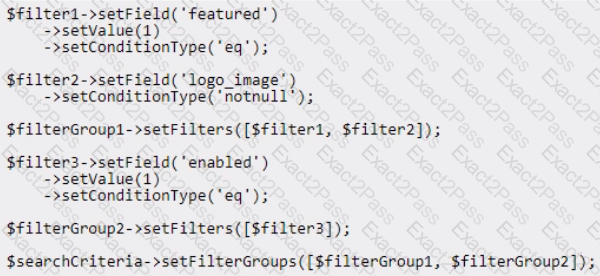
B)
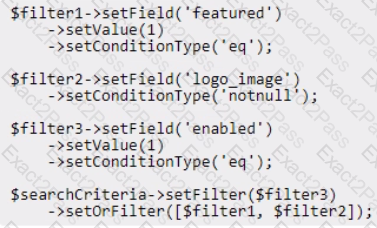
C)

On an Adobe Commerce Cloud platform, at what level is the variable env: composer_auth located in the Project Web Interface?
An Adobe Commerce Developer has written an importer and exporter for a custom entity. The client is using this to modify the exported data and then re-importing the file to batch update the entities.
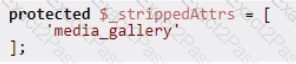
There is a text attribute, which contains information related to imagery in JSON form, media_gallery. This is not a field that the client wants to change, but the software they are using to edit the exported data seems to be modifying it and not allowing it to import correctly.
How would the developer prevent this?
A) Specify a serializer class for the attribute using the $_transformAttrs class property array for both the exporter and importer so it gets converted:

B) Strip the attribute from the imported file by adding it to the s_strippedAttrs class property array:
C) Prevent it from being exported by adding it to the $_disat > iedAttrs class property array:

An Adobe Commerce developer has created a module that adds a product attribute to all product types via a Data Patch-According to best practices, how would the developer ensure this product attribute is removed in the event that the module is uninstalled at a later date?
An Adobe Commerce developer has added a new configuration field to the admin area. The path for this option is general/store_information/out_of_hours_phone.
Keeping simplicity in mind, how would the developer ensure this option contains a valid US telephone number?
An Adobe Commerce developer has installed a module from a third-party vendor. This module fires a custom event named third_party_event_after and also defines an observer named third_party_event_after_observer that listens to that event. The developer wants to listen to this custom event in their own module but wants to execute their observer ' s logic after the third_party_event_after_observer observer has finished executing.
What would the developer do to ensure their observer runs after the observer defined by the third-party module?

